Showing posts with label 782. Show all posts

Friday, August 26, 2016

The House of an audiophile Part 2 - The Cinema and Games room

This article is pretty useless without first reading the Part1, so if you haven't read that you will not understand the whys in this one.

Ok so I dealt with the first part of the problem with Part1... but that still leaves me with the even bigger, even more asymmetrical, prone to echoes and natural amplification of sound Cinema and Games Room.
There is another catch: the living room was supposed to have good sound, but this has to have good and powerful sound! If I'm having a party, this will be the disco.

The geometry, already discusses in Part 1 is...


...challenging.

So, again, after several tests and trials, and the obvious usage of my Galaxy Alpha phone as a sound analyser, I managed to sort things out this way: (for the geeks sake, I'm starting will the schematics and all the goodies, and I'll explain as I go.


 OK so this is far more complex (starting with the inputs... being a cinema and game room and all)!

The inputs start with the so full of glamour and on of the best CDPlayers EVER made the Nakamichi CD2P-E. This thing has been recapped and ouptup XOver trimmed so that all the possible musical details are pickup. This is an example of why a good old 16Bit DAC CDPlayer can eclipse an modern 24bit DAC cd player... I could talk for a year on this, but in very simple terms, think that the analog sound wave that you hear, once digitized is converted to a sort of bar chart of what the music would look like. Obviously, this loses resolution and that is why a true audiophile prefers vinils to CD's.
However, there are some excellent designs out there that can "imagine" the gap between the bars and recover the lost sound-wave. Some are good.. some are great and some are gods.
So in this sense, more bits = more resolution = better sound...no! CD's where recorded with a specific bit-stream in mind... having more bits does not mean that you have more resolution out of the CD, but rather you can decode more at once, and that allows you to have a bit-stream comparison on the recreation of the sound wave that could reduce conversion error.... so a 8 parallel chip 16bit circuit will easily eclipse a state of the art 24bit DAC (if the 16bit chips are really good).

Back then, while Philips created the TDA1541A 16bit DAC chip (and they did a VERY good job at that), they also created what is called a reference diagram, so that integrators could follow and create their own design. These diagrams normally are a schematic build to make the chip work and they are build long before the chip is made... so, by other words, no one ever tested the diagram.
Pioneer, sony, and all the other except Nakamichi and Arcam, decided to copy-paste the schematic and sell cd players.
Did it work? yes! Where they any good?.. no! they where all mostly dull and flat. Nakamichi and Arcam, however, waited for the chip, built their board based on the reference but not blindly, and then tweaked the output and voila! They unlocked the secrets of the brilliance of Philips TDA1541a chip design.
It is one of the best DAC out there!


The CD2P is rare for being very pure and precise in sound image, and shows you the best details in sound. It's that sort of player that makes you re-listen to all your collection because there was just too much you where missing.


As usual, loving he best ever build and being a child from the 70's-80's, I have my Amiga 1200 Tower connected to my media sytem.
You can see it here:

The rest is the typical Nintendo Wii, a Sony PS3 and a Roku3.

The AVR:

The AVR is a Denon4306... a true beast
This, is directly driving the Front L+R, the Midle L+R and the Rear L+R... and then it pre-outs the subwoofer and the Rear and Center channel to a set of slave amplifiers. The direct drive from the Denon outputs 8Ohm at 130RMS watts, and given the generous size of the capacitors, it's no wonder it can drive the speakers without getting tired when a lot of bass kicks in. The Denon has a capacity to resist starvation that is not all that common.


The central front slave to the Denon is no less than a Marantz PM55SE... yes it is a Ken Ishiwata tuned PM55... special edition.
A beauty...with a total harmonic distortion of 0.02%

This then drives directly a pair of B&W DM305. The 305 was an interesting project.
B&W where on the quest for a deep bass speaker made form light materials, that could reproduce across the range and not suffer form brittleness form the light materials resonance, and still provide some bass.
They created a Prism design backplane for the speaker that mimics the attenuator foam form the walls of any sound proof room.


Did they succeed? NO! the bass is to soft (probably attenuated by the prism), however, they are EXCELLENT to reproduce voice channels... like the typical "dialogue" assignment that a THX system enrols the central channel into. So an initial deception as main speakers, transformed into a solution for the central channel. Driven by a powerlfull bu low distortion amp.


Back to the Amps... so I talked about the front, so how about the reinforced back?
The room architecture meant that rear needed power, so instead of buying extra big speakers and loose HIFI, I chose to spread the frequencies across multiple speakers and make a "sound wall".

Welcome to my faithful Marantz PRO PM4400
 Once again, I turn to Marantz this time seeking power and precision.
This beast is directly driving:

 The Mission 773 pair and the Celestion Impact s1 10"sub

The Missions will be talked about soon enought, so let's look at the celestion! This 10" driver with it's own poweramp and XOver, is able of going below 30Hz (normally you would go for a 12" and more to run below 30hz). we can;t however forget that celestion is the brand behing most rock concerts speakers, the bass stations on most dance clubs and, last but not least, a major builder and suplier of drivers for other speaker manufacturers.
Yes, their driver can go bellow 30Hz and still be able to go up to 150Hz because of the stiff and light construction.
 But we are not done with the Marantz PM4400 yet.... out of the back of the Celestion, Xover to 150Hz and up, there are a couple of Mission 772 on a pair of ATACAMA stands.


 Now lets look at the speakers that the Denon drives directly:
Starting with the back (since we where already there), a pair of Mission 774
 On the Middle we have a pair of very powerfull and robust Wharfedale XARUS 4000:


The finally, the best sounding speakers for the money ever built, driven direclty by the Denon on the front R+L channels, a pair of Mission 782.
These are very peculiar speakers that have a very interesting history, please read all about it here.

We can't forget that the mid-to low bass is output by a KEF 1000.2


 The result? please have some pictures:


This is a Video of the Sound quality and image, with "The Verve's - Happy Man" brutal guitar:
Here, it is clear that the camera mic is on the limit with just a simple guitar playing as -20db, and when I up to -10db is just distorts the pickup sound. But believe-me... the listening experience is flawless if you have ears instead of a cheap MIC.


And this is a video demonstrating how easy this handles pure bass, at volume, without distortion or brittleness:
Without surprise, the Mic is not able to perform at -20db with a bass full music, the 10db is just pure distortion on the MIC.

However, looking at the graphs several conclusions can be taken on both videos:
  1. The system is reproducing at 24hz frequency and performs all the way up to 20khz without gaps
  2. When the volume is increased, the system increases db's without compromising the frequencies... they all grow proportionally.
  3. The Bass (hard to equalize) is maintaining the volume without gaining HUMMMMsss or becoming excessive.
  4. The volume at -20db is enough to overwhelm a Splash Action cam's mic...with rock!
  5. The 772 and 773 speakers are operating near the limit on the -10db with bass sound, I'll try to attenuate this in the future, so i can go all the way up to 0db and eventually end up without windows in my place :)


Now about the Missions... all the 772, 773, 774, 782... together with my M73i,  V62 and the Mission built Denon SCM51.

Some would ask, do you have a mission fetish?
No! I have an engineering over economics fetish... that's why.
It's easy to grab the best materials out there and, not minding cost, build a decent speaker that the client would buy for gazillion euro and perform nicely!

Mission is that brand that (in the old days) invested a lot of engineering time trying to create a speaker design that performed the best, and then try to replicate that design with materials that would cost less, so the client would not need to overpay (sometimes this came back to bite them, but some years in and a small research can turn this around in your favour... see my Mission 782 article).
The result is that most OLD missions sound better than their price range. But every now and then they build a product that rockets out of their standard into stratospheric performance.
The 782 is an example of that! It sounds better than speakers costing 10 times as much. Much like the M73i and V62 (after properly sanded with a minimum 2kg of sand) can sound better than speakers that cost 4 to 5 times as much.
The 772, 773 and 774 are a family of speakers that are excellent performers for the price... but within this family, the 774 is the excel. It just sings through the entire frequency range without a fuss.... it's far better than the cost.

Why? Well, just like B&W has John Bowers, Marantz has Ken Ishiwata, Mission had Peter Comeau.
Most speaker I buy are designs produced by or supervised by Peter Comeau. We seem to like the same things and that is very good... plus I love the idea of not paying for others laziness (nor marketing... hence not owning a single Bang&Olufsen).


Hope you like this article... more will follow are there are 5 other audio systems that make me very happy and proud... and will make their way into the next 5 articles, so stay tuned.


Sunday, February 14, 2016

Mission 782 repair

--- EDIT  - please scroll to the bottom of this article for the edit ---

Hi everyone.
It seems that I'm having as much bad luck in transportation services, as I'm having good luck in auction items.

I've been looking for a pair of floor standing mission "old school" speakers.
There is a reason for that: old school mission speakers where made-in the UK (not China like later ones), with excellent craftsmanship and even better engineering. 
As newer models have been labeled dull and flat, old models, particularly the ones using fixed vented pole designs for the midrange drivers, where something to look for and then keep with.
The mission engineers managed to match the crossovers to the perfect driver for that type of frequency response. This brilliantly mated combination, produces results comparable to speakers costing 5 to 10 times as much. This, to me, was Mission's trademark... archiving results through efficient engineering, beating "costly materials and drivers" with brain. It has everything to do with me...engineering instead blindly mixing expensive components and then making the client pay for it, claiming the old "exclusivity" excuse. 
Don't get me wrong; good materials produce better results, it's just that whenever not so good materials with good engineering produce the same results, then the obvious conclusion is that applying the same engineering effort to better materials would give your client a better "ride for the money"... mission did that for some time and I absolutely respect that.

The 782 are a perfect example of what mission used to be:

Back to my history: after a lot of searching and some frustration trying to convince some ebay traders that there was no difference on shipping a pair of speakers 10 miles of 10.000 miles, one very nice lady accepted my challenge and allowed me to bid on a pair of 782.

The 782 are a brilliant designed true 3way speaker. It features a 13cm midrange fixed vented pole ceramic design speaker on top, together with a 2,5cm silk dome tweeter, both enclosed in the top end of the speaker  on a pyramidal shaped box. Then at the bottom, there is a side-firing 16,5cm woofer made from nomex, that enjoys practically 2/3 of the speaker body box for volume and reflecting.

So summing up, after a LONG search, I managed to source a set of some of the best cost/quality speakers known to man.
There was some degree of risk! The reason that make the 782 so exquisite, is that they where produced for a little time... and that was due to a mid-driver production problem! The original drives that came with the 782 where the Keraform 82-LF130/QS. Excellent design, reasonable build quality but a terrible detail. The coil protective plastic sheet, had a glue whose chemical composition reacted with the soldering on the metal, generating extreme corrosion. This would lead to increase in electrical resistance, reducing sound power and quality, with time the oxidation would inflate the once flat soldering and make the coil rub against the magnet walls and producing heat and drag, and ultimately the degradation would just insulate the parts and the driver is dead.

Most people facing this, just decided to trash or sell the speakers. for some time it was possible to buy replacement parts from Keraform, but, in time those would have the same fate.


Obviously, Mission was aware of this and discontinued the series, then instructed the technicians to accept warranty repair claims, and substitute the driver with the Audax HM130Z0 Aerogel units. These where better, more expensive drivers that would perfectly replace the Keraforms without impact in sound quality/image.


So there are some 782 out there that whee trashed, others where sold as repair item, others for parts, others perfectly repaired and updated... and of course, the original ones... few in working order.

I knew this; I accepted that ... and even managed to find a set that was original and in perfect working order. Sure i was expecting some soldering degradation, but I would be able to peel off the plastic, clean the chemicals and re-do the soldering and wrap the coil back with a non acid glue. This, unfortunately never came to be. My couriers, managed to kill the midrange drivers on both speakers. I'm working out the insurance claims at the moment, and apart from some very unpleasant dealing with customer care, the escalation seems to work... so I'll wait until I add to this article the details... either for the best or the worse of it.

While grabbing the speakers I immediately felt a heavy item loose inside one of the speakers. Bad news for sure, confirmed when opening the speaker:
The front protective cover has the pins broken and clearly had suffer a large squashing impact.
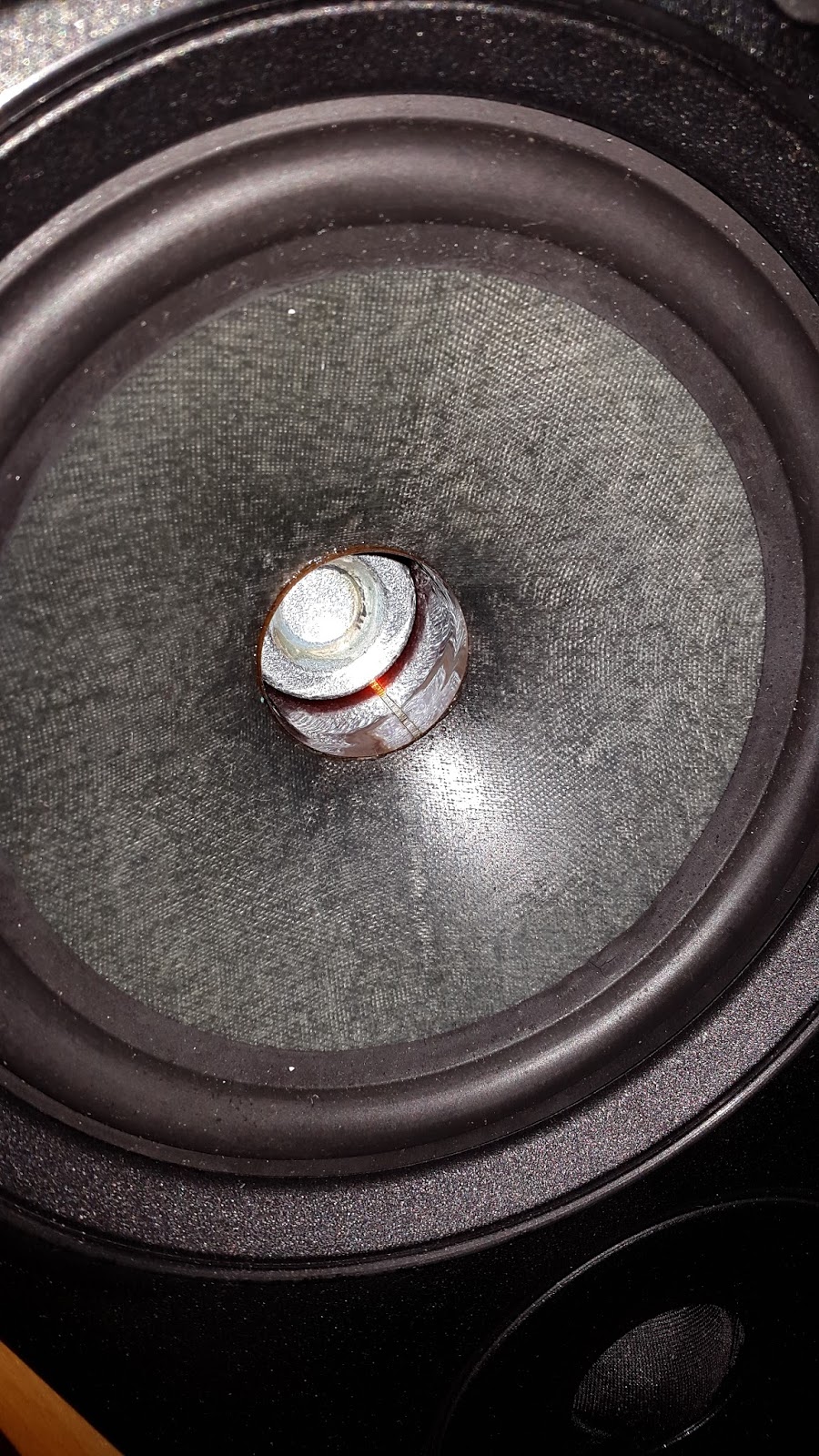
A hole was easy to spot where the cone pole would be, and the inner speaker baffle filling was observable.
In panic, I immediately rushed to the next speaker... no good news there either:
The center pole was loose, running around the speaker driver, however no heavy loose part was felt and the mounting point of the cone pole was still in place. but the pole was broken and heavily marked. 


Ok... time to access the total damage on the first speaker:

First I toolk a clamp to remote the broken plastic pins that used to hold the protective front cover. then, using a screwdriver, I gently removed the rubber housings, exposing the Philips screws.


Then I removed the front assembly, which holds the tweeter.

I finally removed the driver assembly and got hold of the destruction:

Whatever hit the driver, pushed the cone pole in, with enough force to rip the magnet from the driver structure, then the weight if the magnet ripped the wire plug wide open. 


This is the dismantled driver.... and, of course before any attempt to fix, a conductivity test was taken...

At least the tweeter was in perfect order


So conclusions: the main drive was dead...by many different forms of assassination attempt all at once. Independently, I would not foresee a bright future ahead of this speaker, it is an original Keraform, and the oxidation is way into the soldering.
on the inner side, the bump is the result of extreme oxidation process.


Conclusion: I've made an insurance claim for the transportation, ordered a couple of AUDAX aerogel, and I'm now waiting delivery. Will update this post soon.

UPDATE:
So the AUDAX drivers arrived. They are a thing of beauty, but their cast ring is bigger than the Keraforms... a lot bigger. They are also made from aluminum instead of plastic as you would find in the Keraform. In essence, they are a lot better built.


Step 1 -  place the old Keraforms on top of the new AUDAX and use a light colored pencil to template the cutting line on the aluminium .

2- use a dremel tool to cut the excessive aluminium. MAKE SURE you protect the new cone from debris... I just covered it with gum-tape.


3 - Start cutting,

4 - After cutting the metal from the driver, put it next to the wood and template the extra cut... the better you cut the metal, the less you need to adjust the wooden part.

5 - Place the driver and use the drill tool to have new holes for the drivers screws.

6 - Place everything back together and enjoy your brand new UPGRADED Mission 782. These will not go bad of fail...and they sound a lot better than they cost.


----- Edit -----

Hi everyone again.
I decided to update this article as several of you commented on the original and some new ideas came into play.
First of all, thanks for commenting. It's a joy to know that this article has been helpful to others and that they also share their knowledge.This is what the web is all about.

Now starting with what got me into this edit: I recently upgraded my cinema & games room (yes I'll be updating those too), but by removing 2 slave amplifiers and buying a clone for my Marantz CD5000, left me with a surplus of 2 Marantz amplifiers (a PM 4400 and a 55 Special Edition) and a NAD C520 cd player.
Since I spend more time at the office than at home, I decided to move the PM4400 and the NAD to the office. All I now needed to do was to source a set of speakers.

More or less at the same time, my cousin decided to build his cinema and audio listening room. I managed to go to my first choice in audio - my good friend Bob  . While searching for the items my cousin would buy, I managed to find 2 pairs of 782s... and then later that day, while explaining him how much better these are when upgrade-repaired, I instantly started finding myself going upstair and listening more and more on my 2 782's.
Weeeeellllll my cousin only neede 1 set, so i brought the other set for my office.

The set I brought has 1 driver faulty and the other driver already replaced by mission like Chris Galloway stated on his comment. I thought this would be an excellent time to look at what misison built audax drivers would look like and perform.
I also thought, this is a good time to put in practice Adrian Vos method of fitting the driver in one of them, vs my old method on the other.

ALSO, AUDAX continued to evolve the good old HM130Z0... not in it's last iteration as HM130Z12, it has a better plastic seal of the foam dumper, better coil and magnet so, by reason, should sound even better.
So yeah i brought 2. This time i chased AUDAX website, only to get to AAC's website and finally there, source the distributors. I chose the first entry - AARV and got an excellent deal and very decent shipping.


So now for some conclusions: 
The Mission AUDAX made replacement driver vs the AUDAX HM130Z12.
The difference is clear. The AUDAX HM130Z is a loaded, heavy magnet, very robust beast. The mission driver is not only smaller but also plastic structured and clearly not as robust.
In the end, the Mission driver is very good, no doubt and the sound it outputs has an excellent image and is quite refined, however, unless I'm loosing it, I believe that I got slightly more detail on the HM130Zs, particularly at louder volumes.  It doesn't come across as a surprise as, this being a device that produces precision mechanical waves, the more robust it is framed, the better it insulates the thrust into actually producing what it's being asked for.


The repairs:
As expected, the un-repaired KERAFORM unit was long gone and looked even worse than my previous ones.


So deciding to go for both drivers, I then went for on driver on my method, grinding the outer frame out and fitting it in:


And for the other, I decided to give it a go on the Adrian Vos method. in essence I decided to dremel the driver contour out:


 and then groove in steps of 2mm up to 4mm


And then, peel GENTLY each 2mm thick slice and go on to the next until I had a 4mm socket to place the driver in

]


This is the end result.


Comparing the methods, 
on the left Adrians method, on the right my old method


Final marks:

Andrians method is MUCH FASTER AND EASIER. It also requires you to know how to manage a power tool and have firm hands, or you will end up defacing the speaker's outer wood shell. I still prefer my method as the final package looks tighter, but I find no difference in sound.

HM130Z's vs Mission own driver - IF you have the keraforms, you should opt for the HM130Z, else if you already serviced your speakers and have the mission aerogel AUDAX replacements, I don't believe the effort is worth it except if you are really trying to get the absolute best possible sound out of it. If, like me, you really want these babies to eclipse much higher line speakers, then the 110 euro it's gonna cost you, plus the afternoon grinding metal and wood is worth it.
But the mission aerogel is a very good option and certainly costs half the money and 1/10th the effort.

HM130Z0 vs HM130Z12 - If buying for the first time, go for the 12's, if you already have the 0's the juice is not worth the squeeze... but you can always try to use Adrian's method and simplify the "squeeze".

It ends up being a "do you pursue audio nirvana or not?" question.

I'm now the happy owner of 2 pairs of repaired/upgraded 782's and the guys at the office went crazy when they started singing. They've just finished the run-in... boy do I love these speakers.

--- re-edit for location tips and sound test with spectrometer ---


Positioning of the speakers in the Room:


The speaker on the rigth should be another 20 cm away from the wall, but this IS a meeting room and function takes precedence! That board has given birth to some preety spectacular ideas that help paying for all this stuff so... 


As you can see, sound is coherent both next to the speakers and on the far side of the room. 
This room has carpet and sound/heat insulation on both ceiling and walls, so not the best for sound propagation (thought rather good avoiding weird echos).

The spectral analisys shows very pleasent sound pressures across the frequencies, without excessive high frequencies and excessive low frequencies.

:)


ohhh and the treble, bass balance are all neutral, and loudness is off